Photo by Kanchanara on Unsplash
Who Started Bitcoin?
The name synonymous with Cryptocurrencies and the beginning of Bitcoin is Satoshi Nakamoto. This is the name given to the person said to have created the first blockchain database and Bitcoin’s original reference implementation known as either ‘Bitcoin Core’, ‘Bitcoin’ or ‘Satoshi Client’. This is a free and open-source software written in C++. These developments marked the beginning of the first wallet and blockchain validator. Satoshi Nakamoto has not been heard from since April 2011, and his name is believed to be a pseudonym.
Bitcoin
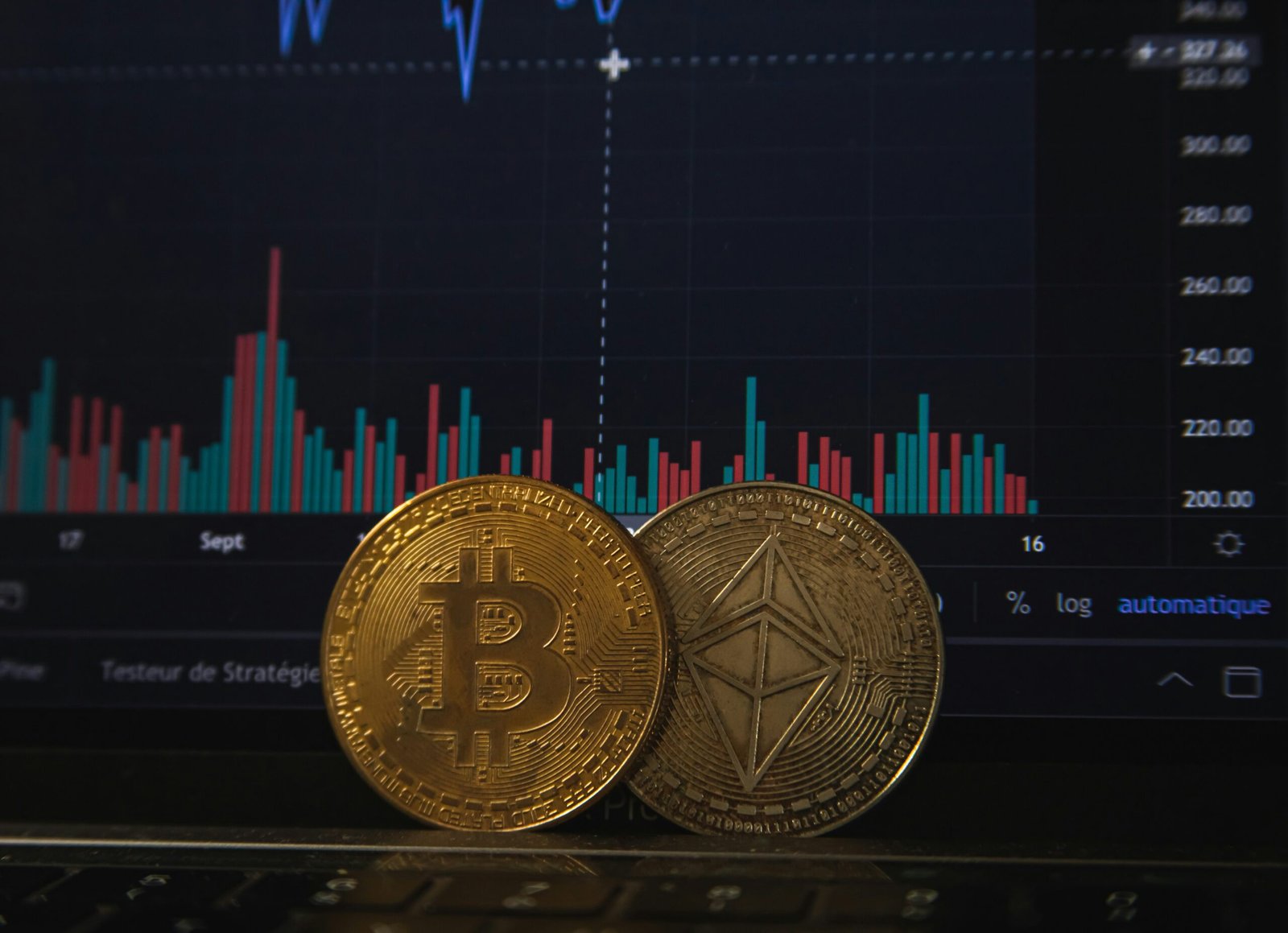
In 2011, the Winklevoss twins of Facebook fame, revealed that, through their investment vehicle ‘Winklevoss Capital’, they owned 1% of bitcoins in circulation. Worth around $11 million at the time. On the 30th of April 2011, 1 Bitcoin was valued at $3.44, by the 6th of October 2025, 1 Bitcoin was worth $126,080. As of writing, January 2026, Bitcoin is valued at $78,628.50 which speaks to its price volatility. In October 2015, the Winklevoss twins opened an American cryptocurrency exchange called Gemini. The platform allows customers to buy, sell, store, and earn interest on digital assets.
Ethereum
In order to better, understand Bitcoin and its major competitor, Ethereum, it may be useful to understand how cryptocurrencies work and what they are. In order to answer these questions, it’s necessary to break down the terms. The currency part refers to money and, crypto refers to cryptography.
 Anyone who has seen the 2001 film ‘Enigma’ may be aware of some of this terminology. The film is set during the second world war when a group of scientists headed by Alan Turing (pictured left) at Bletchley Park in the UK, were tasked to decode the ‘Enigma’ machine. The ‘Enigma’ machine was invented by Arthur Scherbius, a German electrical engineer, for the purpose of encrypting (disguising) banking transactions and diplomatic messages. The ‘Enigma’ machine worked by creating coded algorithms and transforming readable data also known as plaintext, into unreadable text.
Originally invented for peaceful purposes, during the 1920s it was adopted and modified by the German military. It famously became a major resource for secret messaging during the second world war.
Such was the concern around the German’s ability to communicate secretly, that a team of British and Polish codebreakers were assembled at Bletchley Park in the UK with the sole remit to break the code. Alan Turing and his team eventually discovered the machine’s mathematical weaknesses and were able to return the encrypted messages back to a readable form. This had a major impact on the outcome of the second world war in terms of victory and duration.
In this context, crypto relates to cryptography, a way of hiding information, making it secure and secret. Cryptocurrency is digital money that is stored on computers but is secured by cryptography. Because it is a digital currency, there are no physical coins, they are literally stored as data on computers. There are a number of different currencies that you can purchase such as Bitcoin, Dogecoin, Ethereum, Litecoin, Solana and Tether.
Blockchain
Those of you who remember Napster, will know that MP3 audio files were shared using something called ‘Peer to Peer’. What this means is that each individual user acted as a node on a decentralized network. Napster users shared the audio files on their computer hard drives allowing other users to download files.
Napster is often compared to the Blockchain because both utilize ‘Peer to Peer’ (P2P) decentralized networks in order to dispense with traditional intermediaries. Napster allowed for a decentralized (P2P) network to share audio files. In this context, the Blockchain is similar but instead of sharing audio files, it shares value / data transfer in terms of digital assets.
The beauty of the Blockchain is that does not just record one transaction in one place. In fact, a single transaction will create duplicate complex, bundled sets of data that are added to the ledger as part of a block. Think of the Blockchain as an online ledger where transactions are recorded multiple times on multiple computers. The blocks are compared to each other to make sure that they are correct.
Bit Coin Mining
You may be wondering who maintains the ledgers and creates the blocks on the blockchain. This is the job of Bitcoin miners who use banks of computers, often buildings full of computers to solve complex cryptographic puzzles using ‘Application-Specific Integrated Circuits’ also known as (ASICs). This is done in order to secure the network, process transactions and mint coins. All the transactions are bundled into blocks and placed on the decentralized ledger. The miners then earn rewards as Bitcoins.